
A 685-home master-planned village at 207 Broulee Road, currently lodged with Eurobodalla Shire Council.
At 207 Broulee Road, between the township and the bush. A site of paddocks and remnant eucalypt forest, sitting on a low ridge that runs roughly east–west and opens out to a long view toward Broulee Island and the Tasman Sea.
It’s bordered by Broulee Road to the south, George Bass Drive to the east, Carroll College next door, and a band of native bushland along the north and west. The ridge has been farmland for generations. The work of farming it slowed long ago — the paddocks are largely cleared, and putting houses here doesn’t displace a working farm or a stand of forest. The bush along the boundaries has been undisturbed for longer.
The masterplan starts with what’s here. The conservation areas trace the existing vegetation. The roads follow the natural contours. The homes sit where they best catch the view without taking it from anyone else.
The masterplan was drawn by URBANEW in response to the site’s three defining features — the ridgeline, the native vegetation, and the distance to existing services. What follows is the plan as most recently lodged with Eurobodalla Council.
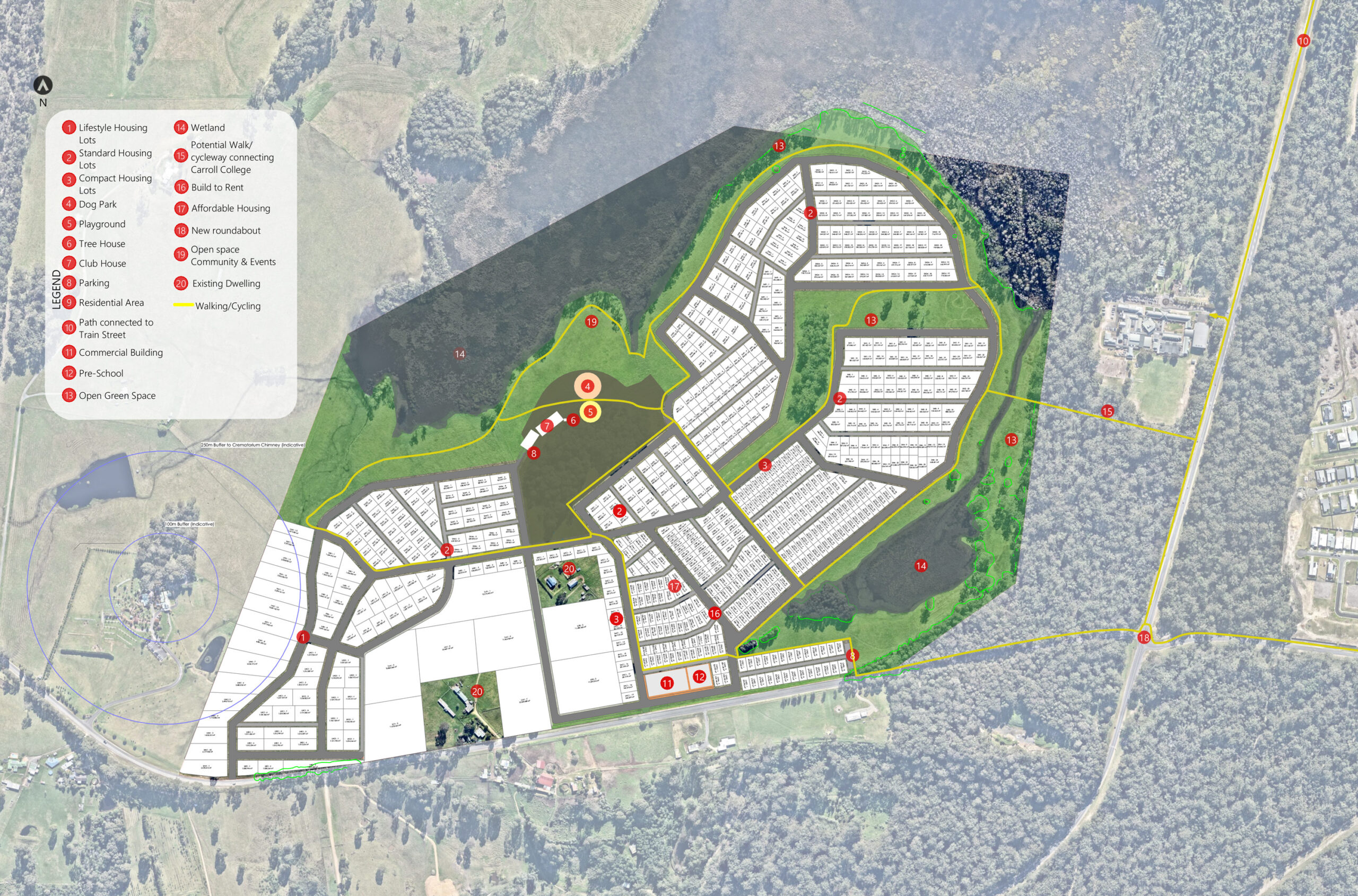
685 lots across four size categories, with two long-term tenure commitments held within them.
| Lot type | Lots | Minimum size |
|---|---|---|
| Compact | 293 | 300 m² |
| Standard | 331 | 550 m² |
| Lifestyle | 51 | 1,000 m² |
| Large | 10 | 1 hectare |
| Total | 685 |
Within those 685 lots, two long-term commitments:
The design didn’t start with how many homes could fit. It started with what shouldn’t change.
The native vegetation along the north, west, and south of the site is preserved before any lots are drawn. About 30.8 hectares — close to a quarter of the site — remain as conservation land, managed for biodiversity and connected by trails rather than cut by roads.
The trail network runs through the village rather than around it. From most homes, the schools are walkable, the bush is walkable, and the township is a short ride. The car is for elsewhere, not the everyday.
A single development that supports families through different stages, downsizers staying in the area, locals needing long-term rental, and young households trying to enter the market. Four lot sizes and two tenure commitments in one village, by design.
Five per cent of homes stay affordable in perpetuity, rented at 20% below market through a Community Housing Provider. Five per cent are build-to-rent housing for local renters. The Key Worker Finance Scheme runs alongside, helping young families and key workers into ownership. These aren’t temporary marketing positions — they’re long-term commitments that outlast the development.
The site borders rural properties, a school, a road, and a crematorium. Each edge is treated differently — native planting strips, conservation buffers, set-back built form — so the village reads as part of the landscape rather than imposed on it.
Five per cent of the 685 homes — around 35 — are long-term rentals held affordable in perpetuity, offered at 20% below market rent to moderate-income households. They’ll be built and managed by a Community Housing Provider. The affordable designation doesn’t lapse — the homes stay in that role permanently, rather than converting to market rate after a fixed term.
Another 5% — also around 35 — are build-to-rent housing for local renters. Long-term rental homes that stay in the village rather than being sold off.
Alongside sits the Key Worker Finance Scheme, providing 100% finance for key workers — designed to help young families and the key workers who keep local services running (nurses, teachers, paramedics, and the doctors at the Eurobodalla Regional Hospital) into ownership.
The commitments outlive everyone involved in making them. We think that’s the right way for a village to start.
Close to a quarter of the site — 30.8 hectares of native eucalypt forest, banksia heath, and remnant coastal vegetation — is set aside as conservation land. Not as buffers retrofitted after the lots were drawn, but as the starting condition the masterplan was built around.
The conservation areas remain connected to the bushland beyond the site boundary. Trails through them are designed to minimise edge effects on the vegetation. Native planting strengthens the corridor over time. Water management mimics the existing drainage rather than diverts it.
Broulee Ridge is a rezoning proposal currently with Eurobodalla Shire Council. Council planning staff are finalising their recommendation, which goes to Councillors for a vote. If the application passes that vote, the formal community consultation window opens — a chance for the community to make submissions before any final decision is made.
Brightway will be running its own engagement alongside that consultation — information sessions, feedback opportunities, and a place to ask questions or tell us where we’ve got it wrong.
The plan isn’t locked. Your input shapes it.
The masterplan was drawn by URBANEW. The proposal is by Brightway Development Group — sibling to Talee Estate and the Legacy Housing Pledge.
As the project moves through Council and beyond, we’ll share:
Roughly six emails a year while we’re at the consultation stage. More if there’s something worth saying.
We’ll email occasional updates on the project. We won’t share your details. You can unsubscribe at any time.